Made New Foundation A presentation by Steve's AI Consulting

Prepared for Made New Foundation · November 2, 2026

Reach more people. Fund the work. Prove it works.

A plan to put Reimagining Reality in more rooms: more grants, partners and stages, a free resource line and law tracker for your network, and VR scenes that answer back. AI does the drafting; your team approves everything.

–RIGHT Grant 4.0 closes Nov 30
–GivingTuesday, Dec 1
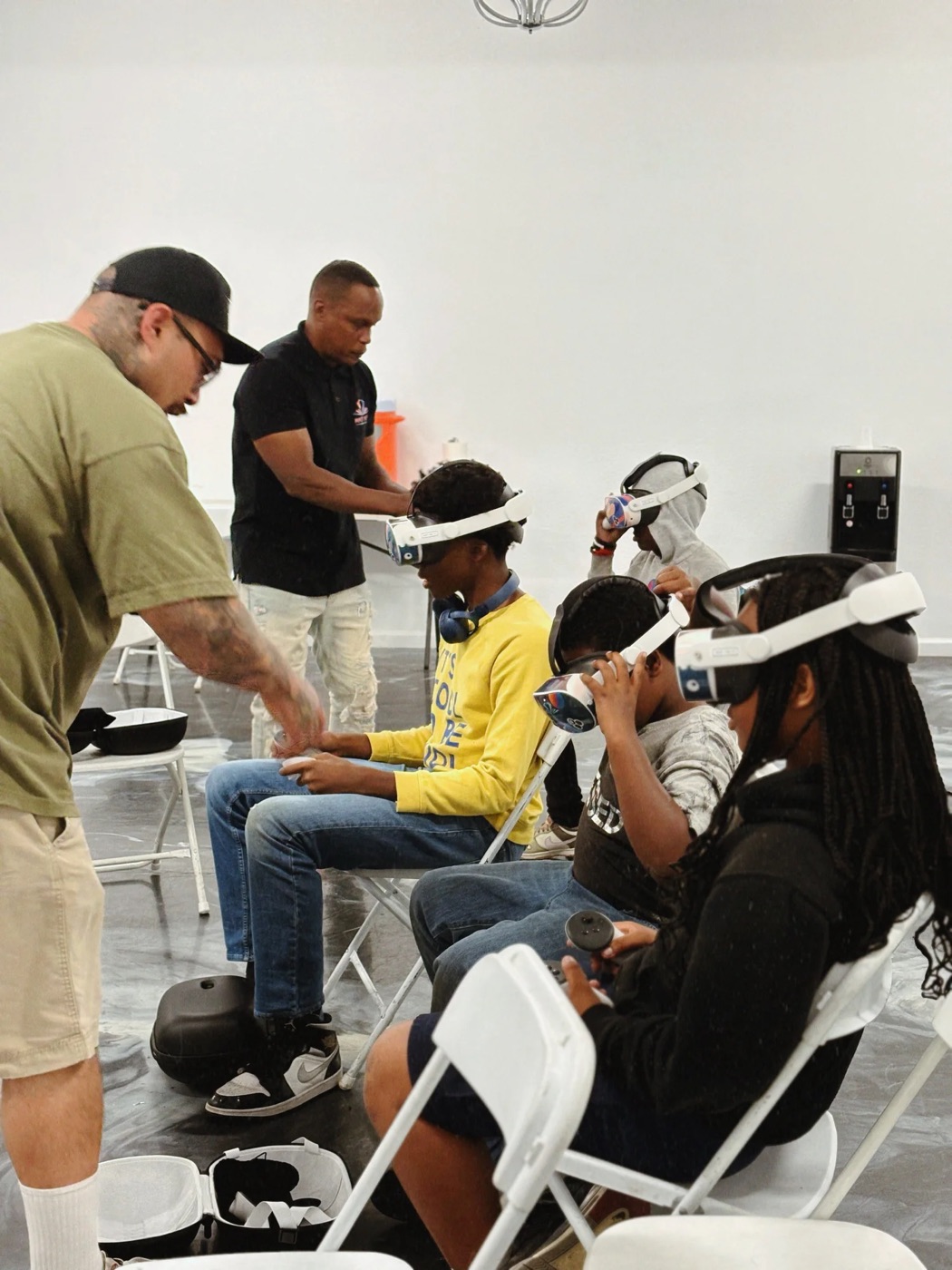
Young people in VR headsets during a Reimagining Reality session, with Made New staff fitting a headset
A Reimagining Reality session. Photo from madenewfoundation.org.
20,565people reached on the ground
22Reimagining Reality programs run
7,419likes on your best post, a creator collab
No list yetthe sign-up form stores no emails today

What Made New gets

Nine builds in three buckets: the service itself, strategy for growth, and the money behind both. AI drafts; your team approves before anything goes out.

1

For the service

What participants and families get: practice that answers back, a number to call, plain-language law news, and proof it works.

For the service · 1

AI inside the headset

Today nearly all of Reimagining Reality is acted video, and none of it talks back. Participants write a scene, play the roles, film it on VR cameras and review it together; the pre-made scenes, like the 2023 job interview and police traffic stop, were filmed with real people. At most, a scene branches at a few choice points.

  • Keep the acting, add a scene partner. Writing and playing their own scenes is the CBT work. AI plays the other person (the hiring manager, the parole officer, the cousin pushing them) and answers differently every time.
  • Ready-made routes run on Quest today, such as VirtualSpeech ($399 a year per person) and Bodyswaps (25% charity discount); a custom build keeps your scenes, voices and data yours.
  • The evidence is strongest for job interviews: in a 2025 trial in Michigan prisons, people who practiced with a virtual interviewer had 3.76 times the odds of a job within six months.

Pilot in Phase 3 · one job-interview scene, 20 participants in the trailer in January

Today · a scene being filmed
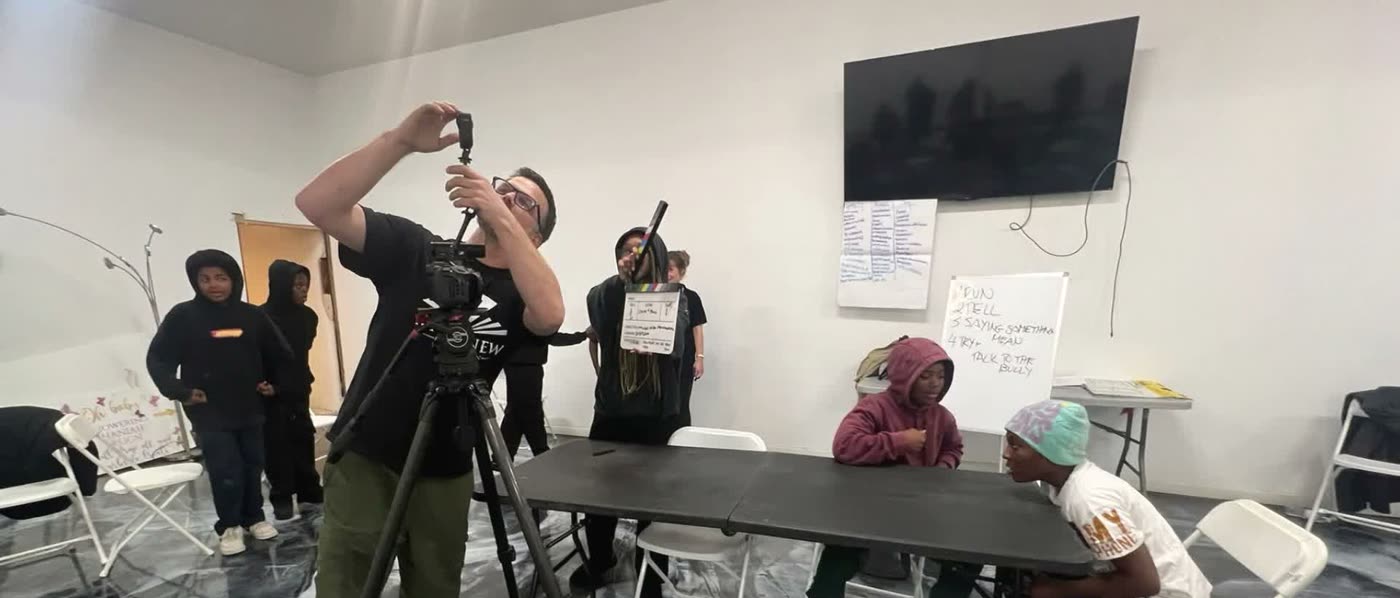
Young participants act a scene at a table while a crew member sets up a camera and another holds a clapperboard
From Made New's sizzle reel on madenewfoundation.org.

With AI · the same scene answers back

A sample exchange. Your team approves every script before anyone uses it.

For the service · 2

A resource line anyone can call

One number for your whole network: people coming home, their families, and people still inside. A voice helper answers in English or Spanish, asks a few short questions, and reads back today's next step from a checked list of LA County resources.

  • Built like SAL, the voice helper Steve's AI Consulting built at the Claude Impact Lab for Illumination Health + Home's challenge. A safety check runs in code first, and the AI never types a phone number; code fills each one in from the checked list.
  • It texts a summary and puts anyone who needs a person in your callback queue.
  • Calls from California prisons are free but capped at 15 minutes and can't be transferred, so for callers inside it takes a message and your team follows up.

Phase 2 and 3 · about $0.10 to $0.15 a minute; 1,000 minutes a month is about $100 to $150

Preview · sample call

A sample conversation. Real answers come only from your checked list.

For the service · 3

A free law tracker on your site

Nobody we found publishes a plain-language, dated list of which new California laws could help someone get out or come home. You can, for free, and it brings families to your site every month.

  • Every week it pulls new bills and laws from Open States and Congress.gov, plus CDCR's rule notices. AI drafts each entry; a reviewer approves it before it posts.
  • Honest both ways: of three 2026 California bills we checked, two narrow eligibility and one stalled.
  • Legal information, not legal advice. It never says "you qualify"; it says who decides and who can help.

Phase 2 · first 20 entries in December · data free, drafting a few dollars a month

Preview · madenewfoundation.org/laws

AB 812 · Firefighter resentencingHelps

Incarcerated firefighters can ask a court to shorten their sentence. CDCR writes the referral rules.

Signed October 13, 2025
AB 1959 · Juvenile life without paroleNarrows

Narrows resentencing for some people sentenced as juveniles to life without parole.

Signed September 27, 2026
SB 672 · Youth offender paroleStalled

Would give parole hearings to people 25 or younger at the time of the offense. Not law; its Assembly hearing was canceled in June 2026.

Status as of November 2, 2026

Legal information, not legal advice. Status from CalMatters Digital Democracy.

For the service · 4

Outcomes desk

Your site counts people reached, not what changed for them. Funders ask for the second. Three questions before and after each session measure the three things your program targets.

  • Emotional regulation, self-efficacy and social awareness, on a 1 to 5 scale.
  • Monthly numbers for posts and reports, and a January impact report.
  • Published research inside CDCR needs its Office of Research's approval first; this is program tracking only.

Phase 1 to 3 · first sessions surveyed in November

Preview · before-session survey

2

Strategy for growth

Social media, press, talks and partners: more people reached, and every one of them kept.

Strategy for growth · 5

Media desk

One desk runs everything people see and hear about Made New: talks, press and posts. You already have what media wants: a trailer anyone can try in minutes, founders whose stories are already news, and people posts that beat headlines by more than ten to one.

  • Presentations. A one-page speaking kit in three formats (a 15-minute story, a 45-minute trailer demo, a 90-minute workshop), a booking page for schools and groups, a pitch for each venue, and a sign-up after every talk.
  • Press. Pitches to the reporters already covering this beat, around real hooks: GivingTuesday, the law tracker launch, the January AI scene pilot, Second Chance Month in April.
  • Social stories. Three drafts a week from your session clips, posted as collabs with @major_cause (8,436 followers) and @sithybin, plus one creator collab a month. Your Glizzy Street collab got 7,419 likes.

Phase 1 to 3 · speaking kit before the November 12 session; first press pitch with GivingTuesday

Presentations · speaking calendar

WhenWhere
Nov 4JCOD Together We Thrive Summit
Nov 10, 17LA County Board of Supervisors, public comment
Nov 12, 14JCOD Care First listening sessions
Dec 2–4CPOC probation chiefs conference, Monterey (exhibit)
Feb 22Speaker deadline, AWE USA 2027 VR conference, Long Beach
AprilSecond Chance Month events across LA County

Press · who already covers this

OutletThey coveredYour angle
APVR in California prisons, Jan 2026Youth who film their own VR scenes
KPBSJuvenile resentencing law, Oct 2026The free law tracker
CalMattersElderly parole law, Sep 2026Who each new law reaches
Signal TribuneSithy Bin's documentary, May 2025Life after clemency
Strategy for growth · 6

Partnerships desk

The fastest way to more participants is other people's rooms. Juvenile court schools, credible-messenger groups and county programs already gather the people you serve.

  • Creative Acts comes first: also in Inglewood, already running VR with people serving life sentences, and Major sits on its board. Co-deliver, or split the field.
  • LACOE runs 11 juvenile court schools, including Nidorf, Los Padrinos and Campus Kilpatrick.
  • The desk drafts each first email and one-page proposal and tracks the next step with each partner.

Phase 1 to 3 · first five emails in November

Preview · partner list

PartnerWhyNext
Creative ActsVR peer, same cityMeet
LACOE juvenile court schools11 school sitesPitch VR
Anti-Recidivism CoalitionCredible messengers insideIntro email
JCOD Incubation AcademyBuilt for lived-experience leadersInterest list
LA Regional Reentry PartnershipNeighbor on La BreaShare referrals
LA Rams communitySoFi is in InglewoodNominate founders
Strategy for growth · 7

Sign-up and welcome

You meet thousands of people at sessions and drives, and keep none of their contacts. One QR card fixes that.

  • Connect the site's sign-up form to a real list.
  • A QR card at the trailer, every event and every drive.
  • A same-day welcome email: one story, one way to help.

Phase 1 · live before GivingTuesday

Preview · printed card

This sample QR opens madenewfoundation.org. The printed card will open the sign-up page once it stores emails.

3

Financial

Grants and gifts: the money that keeps the trailer moving.

Financial · 8

Grants desk

Nine funders have a door open or opening in the next six months. The desk keeps that list current, drafts each application from one shared library, and puts every deadline on your calendar.

  • RIGHT Grant 4.0 from CDCR splits $19.4 million among nonprofits that run programs inside state prisons. Awards are split by points, set by budget size, with extra points for underserved prisons and special populations.
  • It needs CDCR programming in two of the last five years. Your site shows 2024, so the first job is confirming a second year.
  • Google Ad Grants adds up to $10,000 a month in free search ads.

Phase 1 to 3 · RIGHT 4.0 decision this week

Preview · grant tracker

FunderDeadlineNext
California Volunteers, AmeriCorps StateNov 5Only if drafted
CDCR, RIGHT Grant 4.0Nov 30Check eligibility
S. Mark Taper FoundationWindow from DecPrepare
Rosenberg FoundationRollingLetter of inquiry
Ralph M. Parsons FoundationRollingLetter of inquiry
Google Ad GrantsRollingApply

Deadlines checked November 2, 2026. Six of the nine shown.

Financial · 9

Donor desk

GivingTuesday is December 1. Your Zeffy form lists $30, $75, $125 and $300 but never says what each pays for, and never mentions VR.

  • One ask: "Put someone in the headset."
  • A monthly giving circle with a short monthly update.
  • Five posts and three emails through December 31, and a thank-you within a day of every gift.

Phase 1 and 2 · kit ready by November 24

Preview · GivingTuesday email

The coral lines get filled from your real program costs before anything is sent.

How it runs, and where it saves time

Four directors run everything, so every hour of paperwork is an hour away from participants. AI pays off where the same writing, sorting and follow-up repeats every week.

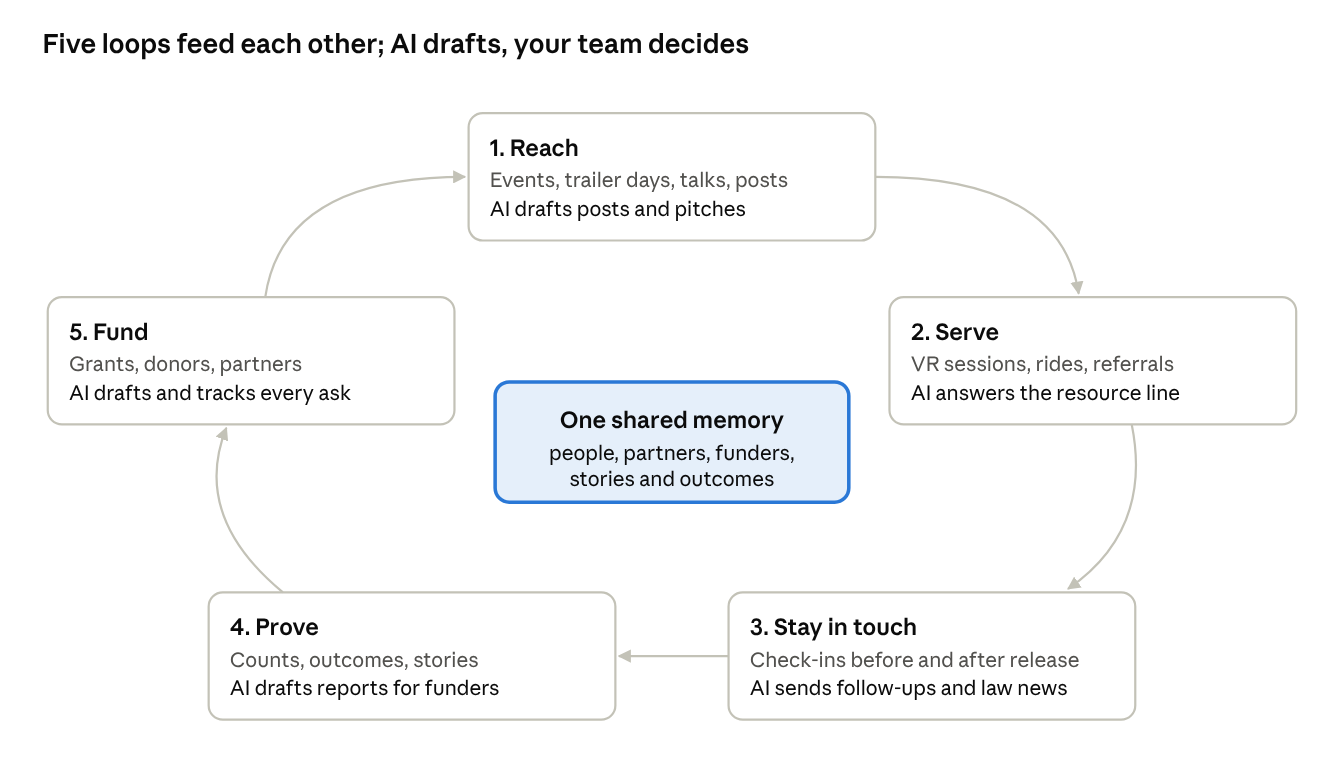
Think of Made New as five loops around one shared memory. A session produces a story and a survey; the story becomes a post and a grant answer; the grant pays for more sessions. Today each loop starts from a blank page. With one memory, every draft starts from what the last loop already learned.

Five loops around one shared memory of people, partners, funders, stories and outcomes: 1 Reach, AI drafts posts and pitches; 2 Serve, AI answers the resource line; 3 Stay in touch, AI sends follow-ups and law news; 4 Prove, AI turns surveys into reports; 5 Fund, AI drafts and tracks every ask.
Work that repeatsWhat AI takes onWhat stays with your teamTime back (planning estimate)
Grant applicationsDrafts each one from a shared library and tracks every deadlineChoose, edit, sign, submitAbout half of each application
Funder reportsTurns session surveys and counts into monthly numbers and quarterly reportsRead, correct, signMost of the assembly time
Resource questionsThe resource line answers day and night and texts a summaryCall back anyone it flagsEvery routine call it answers
Social postsThree drafts a week from session clips and photosApprove; get consentAbout 2 hours a week
Donor thank-yous and updatesSame-day thank-yous, a monthly update, the year-end appealApprove; call your biggest donorsAbout 2 hours a week
Trailer and talk bookingsBooking page, confirmations, reminders, a pitch for each venueShow up and presentAbout 1 hour per booking
Law updatesA weekly scan of new bills and laws, drafted in plain wordsA reviewer approves before it postsNew work you can't do today
VR practice scenesWrites and voices new scenarios in daysTest every scene before participants see itSee "AI inside the headset"

The hours are planning estimates, measured in the first month. The money is concrete: Google Ad Grants gives eligible nonprofits up to $10,000 a month in search ads, Google Workspace for Nonprofits costs $0, and Zeffy already charges you no fees.

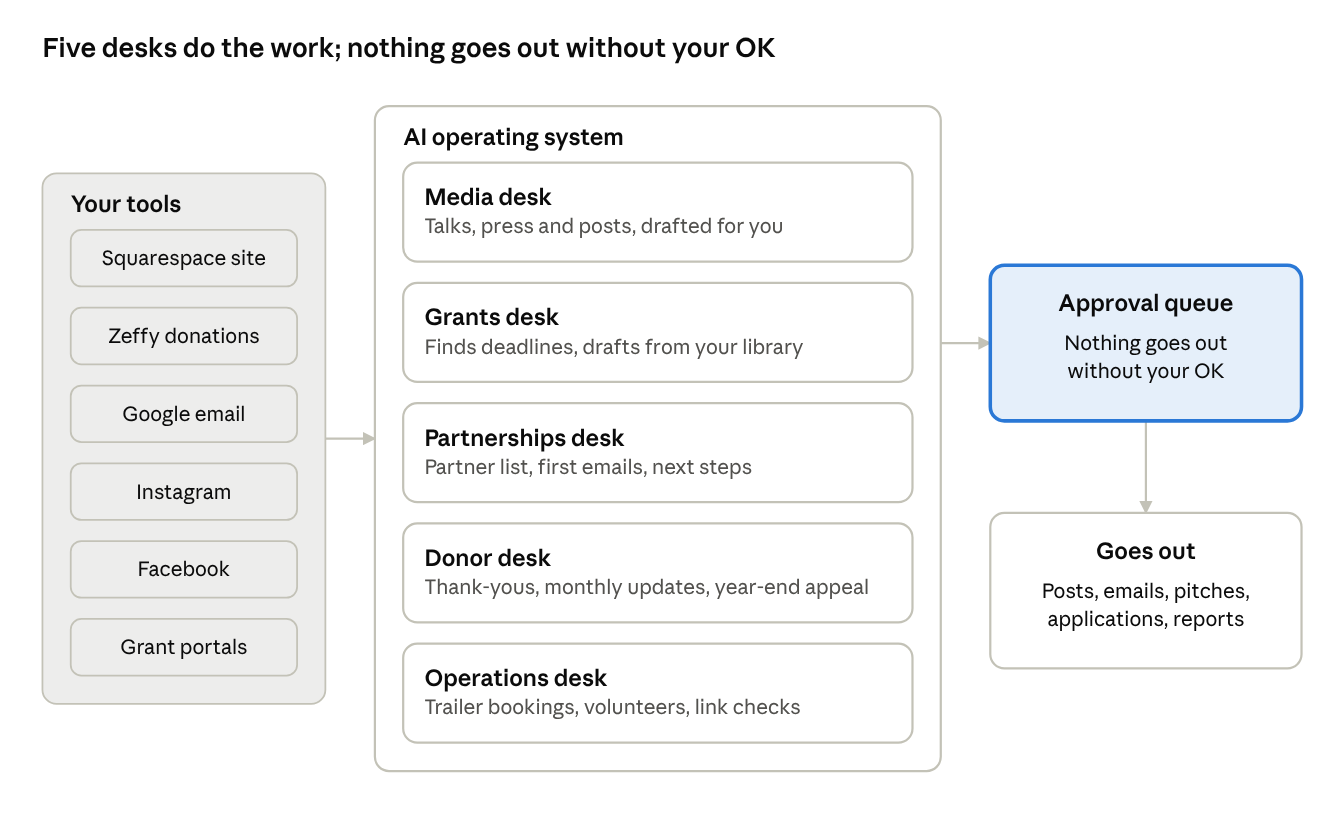
Your tools (Squarespace site, Zeffy donations, Google email, Instagram, Facebook, grant portals) feed an AI operating system with six desks: media, grants, partnerships, donor, outcomes and operations. Everything waits in an approval queue; nothing goes out without your OK.
Nothing goes out without your OK.

Where you stand today

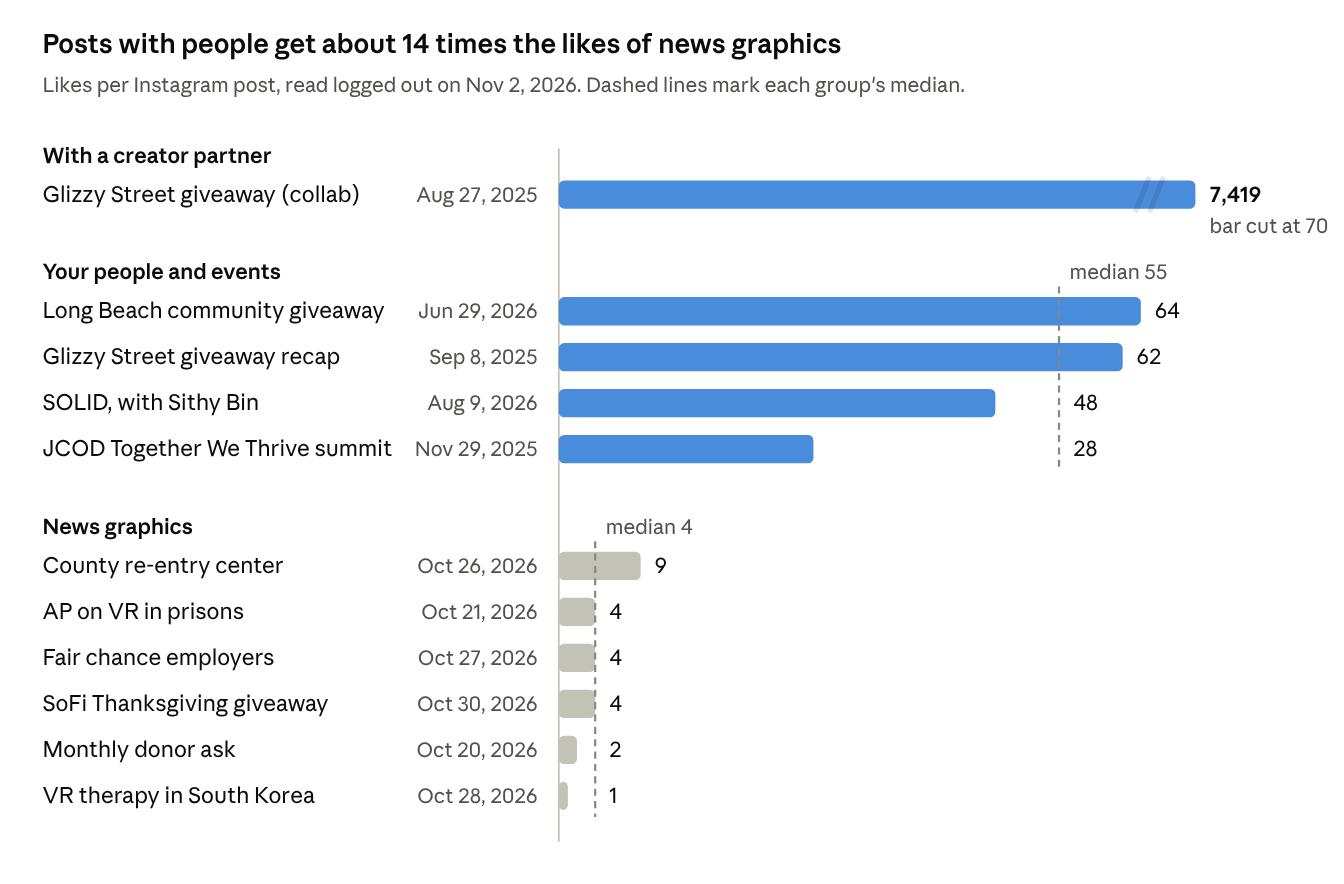
You've built what few reentry groups have: founders who have lived it, and a VR trailer that goes into prisons and schools. The next step is making your posts, pages and donate form show it.

Bar chart of likes per Instagram post. One collab with Glizzy Street: 7,419. Your people and event posts: 64, 62, 48 and 28, median 55. News graphics since October 20: 9, 4, 4, 4, 2 and 1, median 4.
Likes per post, read logged out on November 2, 2026. The 11 settled posts of the 12 newest.

Nine quick wins, each about an afternoon

WhereTodayThe quick win
Sign-up form stores nothingThe "Stay in the loop" form on every page has no storage connected; Squarespace's own status note on it says so. Not tested by signing up.Connect it to Squarespace Email Campaigns, Mailchimp or a Google Sheet.
Old pages are dead/about-us/, /programs/reimagining-reality/, /programs/reentry-programs/ and /contact-us/ return "page not found"; search results still list them.Four URL redirects in Squarespace.
Donate form tells another storyThe Zeffy form lists housing, job training and GED help, never VR, and its description appears twice.Rewrite it around Reimagining Reality and re-entry, once.
Amounts say nothing$30, $75, $125 and $300, with no line on what each pays for.Tie each amount to a real cost.
Two addresses, two phonesSite: 340 E. Kelso Street, (323) 645-1536. Facebook: 11233 Raymond Avenue, (323) 205-6166.One of each, everywhere, including your Google listing.
Email may land in spamMail runs on Google, but the SPF record lists an old web host and not Google. No DMARC record.Google in SPF, DKIM on, a DMARC record.
A pinned post points nowhereThe September 2025 reel says "Follow @madnewfoundation". That profile does not exist.Change it to @made_new_foundation.
The FAQ points to missing buttonsIt names a "Volunteer" tab and a "Get Started" button. Neither exists.A Volunteer page, or point the FAQ to /contact.
YouTube is dormant2 videos, 7 subscribers, last upload October 2023.Post session clips there, or drop the link.

The 90 days

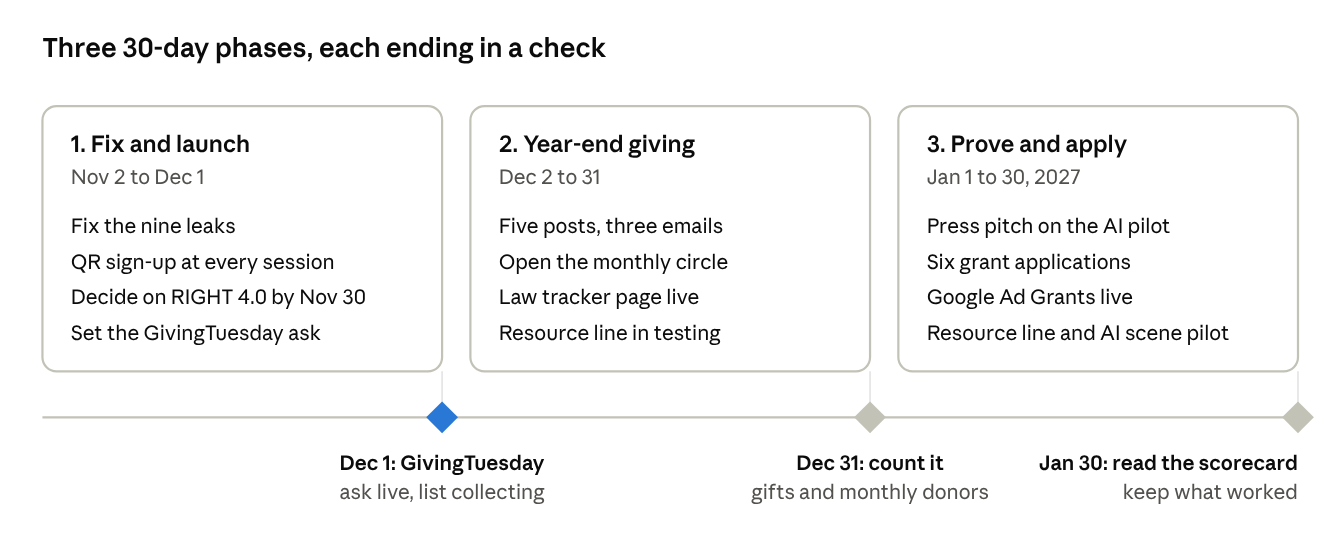
The calendar sets the order: RIGHT 4.0 closes November 30, GivingTuesday is December 1, and year-end appeals run through December 31.

Three 30-day phases. 1, Fix and launch, November 2 to December 1: fix the nine leaks, QR sign-up at every session, decide on RIGHT 4.0 by November 30, set the GivingTuesday ask. 2, Year-end giving, December 2 to 31: five posts and three emails, open the monthly circle, law tracker page live, resource line in testing. 3, Prove and apply, January 1 to 30, 2027: first impact report, six grant applications, Google Ad Grants live, resource line and AI scene pilot.
Each check is a decision: keep, change or drop what the last 30 days showed.

Scorecard

Seven numbers, read on the first of each month the same way, say whether this is working.

MeasureToday (Nov 2)Day 30 (Dec 1)Day 90 (Jan 30, 2027)
Email list0 stored150400
Monthly donorsNot visible1025
GivingTuesday and year-endNo campaignCampaign liveTotal reported
Grant applications submittedNot visibleRIGHT 4.0 decided6
Sessions with a before-and-after survey0 seen50%100%
Typical Instagram post (median likes, last 10)42540
Broken links and pages900

Targets are an illustration, not a forecast. At twelve months, about 150 sign-ups a month and 1 in 20 giving monthly at $40 would mean about 1,800 people on the list and around $38,000 a year in monthly gifts.

What this could not see

Next step

One 30-minute call this week settles three things: whether you qualify for RIGHT Grant 4.0 before November 30, which three builds start first, and who on your team approves drafts.

Who builds it

Steve's AI Consulting builds AI tools for organizations that serve people in hard moments. At the Claude Impact Lab in October 2026, working on Illumination Health + Home's challenges, it built SAL, a voice helper that matches people leaving care to checked resources, and Fetch, which checks referral packets and won the event. The resource line in this plan starts from SAL.

Every build here works the same way: AI drafts, your team approves, and nothing goes out without your OK.

Sources

Every page below was read on November 2, 2026.